 I swear, I’m not a hoarder. In fact, with something like 49 moves under my belt in my 31 years, it’s quite the opposite. I’d much rather toss/recycle/give something away than have to lug it to a new location. Buuuuuuut, the other day after juicing a bunch of citrus fruit, I couldn’t help but think that there might be something we could do will all of the empty rinds (please tell me some of you do this too). Not knowing what it was at the moment, I tossed them all into a container in the fridge and decided I’d figure it out later. Sure enough, a couple of days later as I was grabbing something from the fridge, I remembered the very unique bird feeders I’d seen on Happy Hooligans a few months back. Gracen loves birds and we love to keep our backyard feather friends well fed, so I decided we’d make our own version of the project.
 First, we gathered a few things from around the house… The rinds, some baker’s twine (Greenmunch is a great place to buy it, plus everything party, mason jar, and crafting related!), an large embroidery needle, and a pushpin.
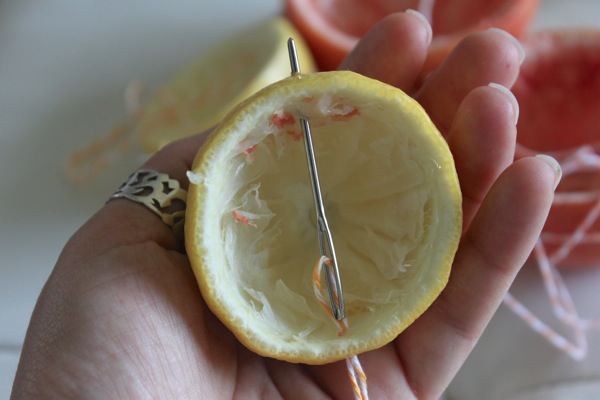 After threading our needle and tying a knot at the end, we pushed our embroidery needle through one side of our citrus cup, straight through the other side. I thought we may need the tack to start our holes, but we totally didn’t (though you might if you had a particularly tough rind). I did the poking, and Miss G did the pulling through part.
 With the twine pulled all the way through, we pulled up the centre to create a long loop for hanging.
 Next, we did a quarter turn and fed the needle straight through the rind again, this time perpendicular to the first set of holes.
 Then we pulled the second centre string up to meet the first and tied a knot on the outside of the citrus cup in order to secure everything.
 While she helped me ‘sew’ the first couple of rinds, Gracen discovered that she could make some pretty interesting creations with the extra citrus cups and pushpins, so that’s what she did.
 This little lemon went from having ‘pokey hair’ to being an octopus, to being a porcupine, and many other things along the way.
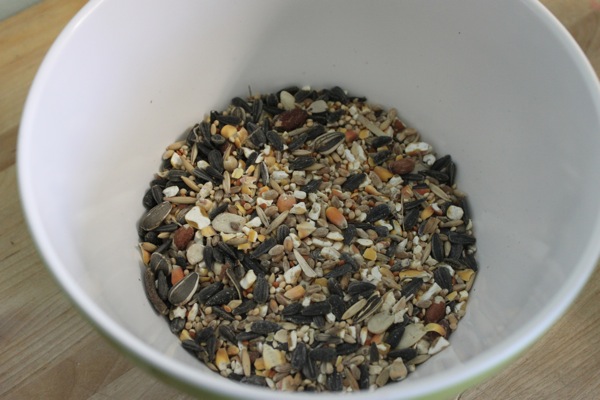 When our citrus rind cups were complete, we focused on the food portion of the process.
 All we did was take some bird seed (we used a wild bird variety), and mixed in a tablespoon of all-natural peanut butter for every half cup of seed in order to give it some ‘stick’.
 Then Grae carefully filled the cups with the sticky seed mixture one scoop at a time.
 We used 1 1/2 cups of seed with 3 tablespoons of peanut butter and it filled 2 grapefruit cups and 2 lemon cups until heaping.
 With that, it was off to hang the new feeders in the backyard.
 Gracen was very specific and knew she wanted one in our apple-pear tree, one in our fig tree, and one in our plum tree… And the other one got hung in our rose bush.
Now let’s bring on the hungry birdies!
See our other bird feeders here and here.
♥
For extra fun, like us on Facebook here and find us on Instagram here.
 I’m happy to say, our experiment was a success. Not only do we have trees sprinkled with pretty bird feeders (thus some very happy birds), but Gracen was able to do almost all of the steps on her own at our butcher block and there was no stove required.
 Here’s what we used for the project… Bird seed, gelatine, boiling water, straws cut into 2 inch pieces, some baker’s twine, and some cookie cutters and pancake moulds.
 We started off by emptying two packets (not boxes – the above photo is misleading) of plain gelatine into a very large mixing bowl.
 Then I carefully poured in a little bit of boiling water (this is one of the only jobs I did for the project).
 Gracen then stirred the mixture very gently until all of the gelatine was dissolved.
 Next, we measured out our bird seed. We used a “wild bird” variety, but I think pretty much any type would work as long as the seeds and bits are not too big – I think a finer blend works best in this case.
 Then Grae poured the bird seed into our gelatine/water mixture.
 We stirred it for a few minutes, making sure that all of the seeds were evenly coated and that there was no longer excess water at the bottom of the bowl.
 Next, we covered a tray in parchment paper and laid out our cookie cutters and moulds.
 Using a teaspoon, Grae filled each cookie cutter with seed, one by one.
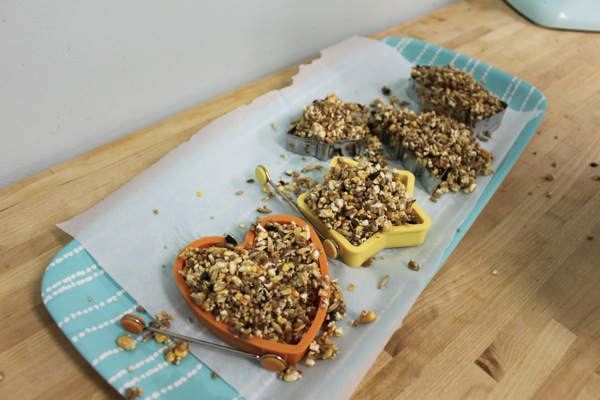 You want to make sure that they’re a little bit overfull, so be generous with the seed. (This recipe made these five feeders, plus a large bird seed “cupcake” too).
 Because the mixture gets really sticky, we covered the cookie cutters with a layer of parchment and Grae pressed the seeds down into the moulds.
 You want to make sure the seeds are packed very tightly – it’s part of what makes the feeders stay together well.
 Next, we took our straws and carefully inserted them into the cookie cutters, making sure to not place them too close to the edges. Once the straws were in the seed, we pressed the seeds down around them to make sure everything stayed tight.
 Next, we popped the entire tray into the fridge and let them set for a couple of hours before taking them out and letting them dry out on the counter. We left them for most of the evening, and before I went to bed for the night, I flipped them over so that the bottoms could dry out too. (It’s a bit awkward to flip them with the straw sticking out the way it is, but you could trim the straw if you liked.)
 The next morning, we gently popped the shapes out of their moulds.
 Then we plucked out the straws and made sure that the holes were clear all the way through.
 For the last step, we took some baker’s twine (ribbon or jute would be perfect too), put it through the holes, and knotted the tops. Voila! Pretty little feeders for the hungry birds in our yard.