

Last Christmas, I made the kids each one of these DIY LEGO kits and I’m so glad I did. They were a super easy project and they’ve been so great for taking along on our travels and vacations. We don’t use them in transit (too many small pieces to be used in a car or on a plane for me), but they’re perfect for down times once at our destination {usually in an airbnb}.

I wish I would have taken proper step-by-step photos of the process, but truly they’re not even needed – it’s so easy.
First off, here’s what I used to make two kits:
- Plano carry kit (set of 2)
- base plate
- mounting squares
- LEGO Classic Creative Brick Box (large)
- sanding block (optional)
- scissors
- ruler
- pencil
Of course if you’re making just one kit, you could get away with a single carry kit, a smaller base plate, and a smaller LEGO brick box. Or if you have a different carry case already on hand, you could easily use that and just refer to this material list and the following instructions as a basic guide. Whatever works! In the past, we’ve even made the most basic portable LEGO kits using old-school metal lunch kits.

Now to make the LEGO kit! Here’s what you’re going to do:
1. Start by measuring the inside of your carry case’s lid.
2. Measure out a piece of baseplate that will fit nicely inside the carry case’s lid and mark your cut points with a pencil. For this particular case, I made my base plate 16 centimetres by 23 centimetres.
3. Using regular scissors, carefully and slowly cut your baseplate down to size.
4. Using your scissors or a sanding block, round the edges of the baseplate piece so there at no sharp / pointy corners.
5. Apply several mounting squares to the bottom side of your baseplate and press them down firmly to ensure they’re well adhered.
6. Peel the sticker backings off of the mounting squares, position the baseplate inside the carry case’s lid, and press it down firmly. I like to take a few minutes and really ensure a good stick here.
7. Place the dividers into the carry case to make sections for the different LEGO colours. I chose to add only two dividers – one between the green and blue sections and one between the orange and red sections.
8. Fill the carry case with LEGO! I chose to separate mine by colour because I’m a total sucker for rainbow anything, but you could do by brick type / size too! Whatever floats your boat.
And that’s it! You’ve got a DIY LEGO kit that’s perfect for taking along on the go.

What I love about this particular carry case is that the clasps are crazy strong, so I don’t worry about them flying open as the kids carry them {and inevitably fling them around – especially in Sam’s case}. Also, I feel like two clasps are always better than just one… Just in case!

The other thing I love? The lids of these particular kits open completely flat, which is so, so helpful when building. (The lids on our metal lunchbox LEGO kits have never opened flat, which can be a little annoying, just fyi.)

Are you following us on social media?
Find us on: Facebook | Instagram | Pinterest | Twitter
We’d love to have you!


 To start out, I carefully made two large perpendicular cuts on the very bottom of the storage unit in order to open it up. Then, very carefully, I snipped out all of the mesh dividers that created the separate compartments.
  Next, using some picnic table covering plastic (found on large rolls at IKEA and hardware stores), I cut out circles just a hair larger than the circular openings along the sides of the tube. With a hot glue gun and a hand I was wiling to burn repeatedly for the sake of my students and soon-to-be butterflies (just kidding…um… kinda ☺), I glued the plastic windows to the inside of my tube to cover up the holes (gluing them to the outside would have undoubtedly been easier, but that would have also allowed my hot glue slip-ups to be more obvious, which simply was not acceptable at the time).
  In order to create some homey resting ledges for my winged friends, I glued several brightly coloured faux flowers to the inside of the enclosure too.
  In the meantime, since we’re not at the chrysalis stage yet, I pinned up the butterfly enclosure, set our caterpillar containers on the little wooden table, and set up a little reading and observing corner for her to enjoy.
  Now to figure out how we’ll hang our chrysalises… While teaching, I stuck them (still attached to their container lids) to the ceiling of a large wooden block that was open on two sides, but since we don’t have one of those, I’m going to have to get a little creative. We shall see what we come up with!
 To get started, I purchased 25 of these flat 5 by 7 paper bags (you don’t want the lunch-style ones that fold out at the bottom) from one of my favourites –
  Then, using one of the stamp sets I use for my
  Next, I selected an area of wall to hang my calendar. I went with this spot because it’s right along the ground and allows Gracen to reach her own bags each day, but you could really do any spot you wish.
  Next, I filled the bags, added a note inside each, sealed them shut with washi tape, and hung them on the lines with mini wooden clothespins.
 Originally, I had really wanted craft paper bags, but I actually think the white ones turned out perfectly. They are just see-through enough to show the shape of the object(s) inside, which gets Miss G really curious.
 This year, because Grae is nearly obsessed with adding to the tree each day, we decided to make her advent calendar all about ornaments. Some days her bag will be filled with a purchased or previously made ornament to add to the tree, and other days, she’ll have to create the ornament first. Either way, there will always be a handwritten note included that tells her why the ornament is special or what she can create using her materials.
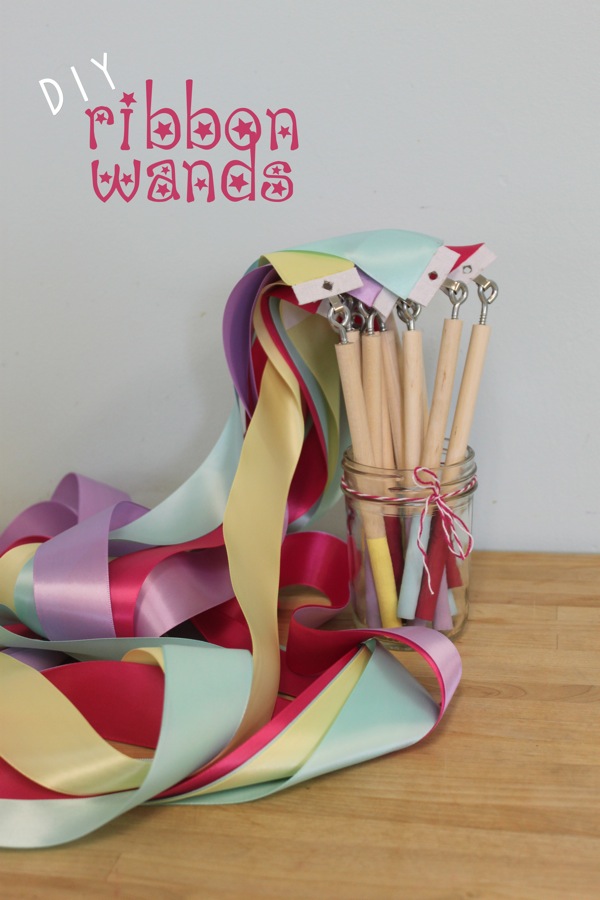 Making one of these sweet little ribbon wands for Miss G has long been on my project list, and since her last dance class took place today, it was the perfect motivation to not only make one for Grae, but to make one to gift to each of her little friends too.
  If you poke around the internet, you’ll find tons of different styles of ribbon wands and methods to make them, but when we stumbled upon these adhesive picture hanging strips (available at hardware stores), we came up with a way of our own.
  First off, we took wide satin ribbon and cut it into strips approximately 125 centimetres long, cutting one end straight across and one end at an angle. Then, using a lighter, we sealed off the cut edges.
 Next, we took the adhesive backing off of the picture hangers and firmly attached them to the straight end of the ribbon. At this point I was going to sew the picture hanger onto the ribbon for added security, but the adhesive was so strong that it wasn’t necessary.
  With our ribbons ready, we moved onto the wand part of the project. Using painter’s tape, we taped off our 6 inch dowels about a third of the way up.
 Then using crafter’s acrylic in colours that coordinated with our ribbons, we painted the bottom third of each dowel with two coats of paint.
 When the paint was good a dry, we carefully removed the painter’s tape to reveal the handle part of our wands.
 Next, we used a tack to poke holes in the top ends of the dowels.
  Then it was time for these guys – small eye hooks available at all hardware stores.
 We screwed the eye hooks into the recently made holes by starting the process by hand and using pliers part way through. (One thing to be mindful of at this point is that if your eye hooks are on the larger side (like ours), you don’t want to force them down into the dowel too far. You’ll get a pretty good sense on when you should stop twisting, and please do so. Spoken from experience, if you force them down too much, the dowels will split open.)
 Your wand should now look like this.
 Now the final step… We hooked the metal picture hanging hook onto the eye hooks and use pliers to squeeze the hook shut tightly.
 And there you have it – a pretty little ribbon wand.
 In order to transport them to dance class without a big tangly mess happening, we simply wrapped the ribbons around the wands, and secured them with a bit of polka dotted washi tape.


 While we were at IKEA picking up a Bekvam stool for Miss G’s
  While Gracen was happily
  After a day’s drying time, my little helper and I assembled them according to the instructions provided.
 Then we mounted them to the wall using plugs and long screws (this was by far the hardest part of the project – really should have used a drill instead of doing it all by hand) and voila – Gracen had instant wall-mounted book shelves.
 These little shelves are all part of a bigger project which I’m doing in honour of Miss G’s upcoming 2nd birthday (which I’ll be sure to share upon completion), but for now, Miss G is loving her toddler-height display-style bookshelves.
 ♥
♥


